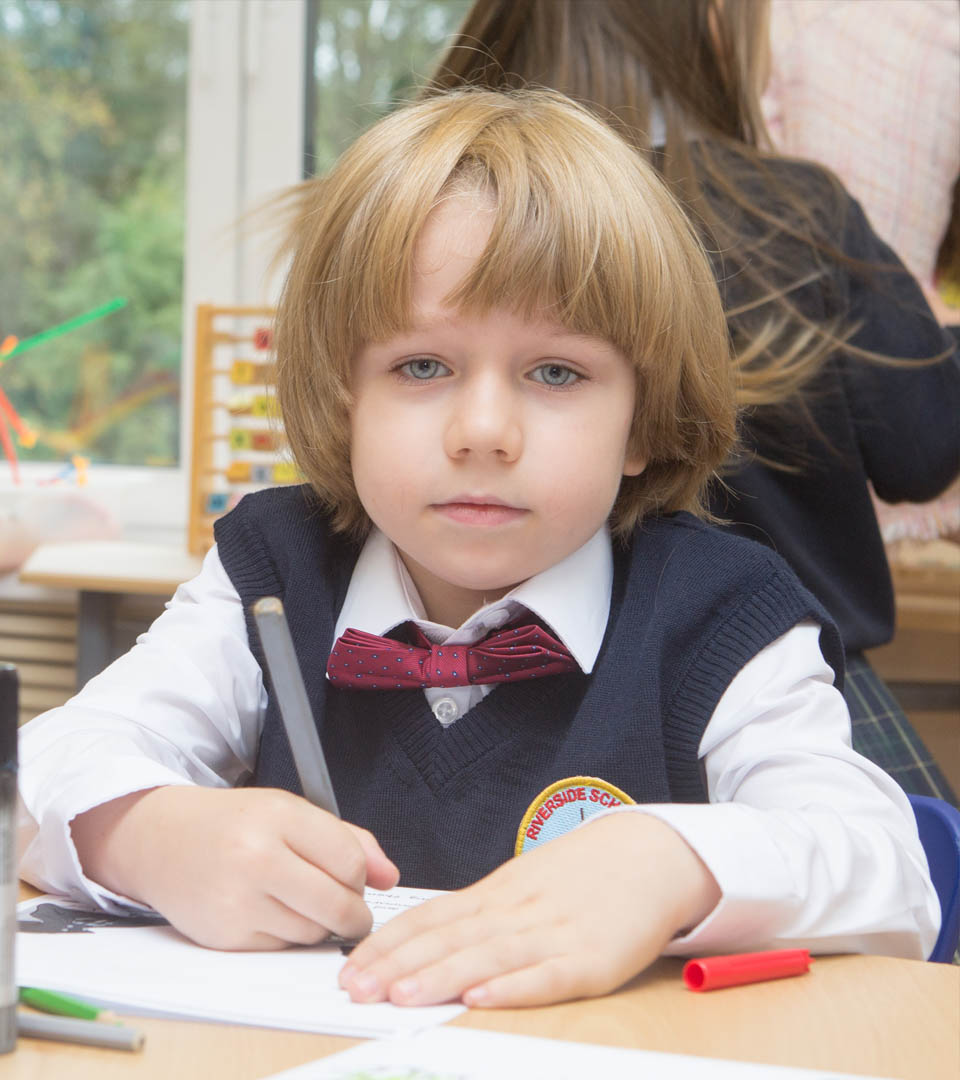
At Riverside School, the Russian and British programmes help children develop subject knowledge, language skills and independence. In the dual programme, English becomes a language of learning: children read, solve problems, discuss ideas and explain the results of their work.
Parents need to understand how the two strands fit together, which subjects their child studies in each language and how the chosen programme takes their previous experience into account.
How the programmes complement each other
The Russian programme provides a structured grounding in subjects in line with the Russian Federal State Educational Standards (FGOS), develops Russian language skills and maintains a connection with literature and culture. The British strand extends opportunities for subject learning through English: children work with texts and problems, make observations, discuss solutions and present their conclusions.
Accuracy, an investigative approach and independent thinking matter in both programmes. Bringing them together allows children to explore familiar concepts in different learning situations and develop subject-specific language in both languages.
Topics may overlap between the programmes. Revisiting a topic is useful when it helps consolidate knowledge, develop terminology or apply a concept to a new problem. For example, a child may confidently solve a mathematics problem in Russian and then learn to explain their reasoning in English. These tasks have different, interconnected goals.
English as a language of learning
Riverside’s British strand draws on the National Curriculum for England and includes English, Maths and Science. The subjects and amount of teaching through English should be confirmed for the chosen class.
In lessons, children read instructions, solve problems, ask questions, observe and explain their reasoning. English gains practical meaning as a tool for learning and communication.
This is an important difference between the dual programme and the Russian programme with enhanced English: the language is also used to study subject content.
Taking each child’s pathway into account
Children arrive at school with different levels of Russian and English. Choosing a programme involves considering age, previous learning, language readiness, overall workload and the family’s future plans.
Riverside distinguishes three formats:
- a Russian programme in line with FGOS;
- a Russian programme with enhanced English;
- a dual Russian and British programme with subject learning in Russian and English.
The availability and content of each format should be confirmed for the particular age and class.
Where needed, families can discuss English support for learning — EAL/ESL — and individual assistance. The format, timetable and terms of support are agreed separately according to the child’s needs.
British Years and Russian classes cannot automatically be matched by number. The appropriate stage is chosen in light of age, the curriculum already studied and the child’s readiness.
Get to know Riverside
Riverside School is a bilingual school and kindergarten in Novogorsk. Current provision includes Nursery, Primary KS1–KS2, Secondary KS3 and Secondary KS4.
The ages 3–18 learning pathway includes a planned 16–18 stage: Russian Grades 10–11 and Sixth Form. The opening year, programmes and admission arrangements for this stage will be announced separately.
We invite parents to visit by appointment, get to know the school and discuss:
- which subjects in the chosen class are taught in Russian and English;
- how the dual programme differs from enhanced English;
- how the timetable, homework and language support are organised;
- how teachers assess their child’s progress;
- which options for continuing education are currently available.
Book a school visit:
+7 (985) 574-31-51
info@rivschool.net
13A, property 1, Zarechnaya Street, Novogorsk, Khimki, Moscow Region.
Compare the three programme formats · British programme · EAL/ESL · Admissions